

Key Takeaways
- Align the demolition plan with OSHA, EPA, environmental agencies, and local building codes from the first engineering survey.
- Coordinate early with health administration officials, regulators, and utilities to manage hazardous materials, live services, and site perimeter risks.
- Keep permits, asbestos abatement records, waste manifests, inspection logs, and updates to the demolition process organized and accessible.
- Treat competent person inspections, fire prevention, dust control, and public safety as continuous duties, not one-time tasks.
- Advanced Health and Safety can support developers with audits, training, and practical systems that keep demolition compliance on schedule.
Introduction: Why Demolition Compliance Matters for Developers
Non-compliant demolition can stop a larger construction program before it begins. Missing permits, undocumented asbestos, unsafe sequencing, or uncontrolled dust can trigger fines, sanctions, lawsuits, and reputational damage with investors, planning authorities, and the surrounding community.
Since around 2020, regulators have focused more closely on environmental impact, hazardous substances, worker safety, and public health during early site-clearance phases. Demolition compliance is essential to transforming dangerous structural teardowns into controlled operations.
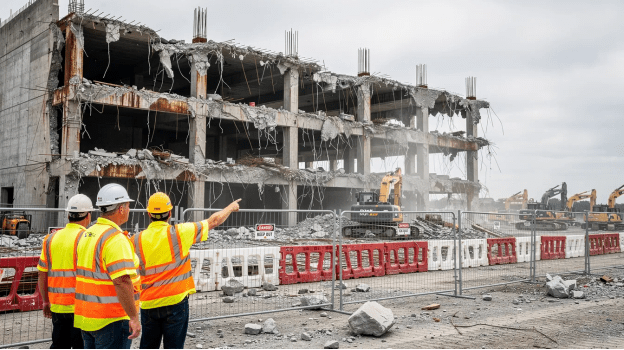
Pre‑Demolition Due Diligence and Regulatory Framework
OSHA governs worker safety and health, while the EPA regulates hazardous materials and emissions. Local authorities issue building and demolition permits. In the U.S., OSHA's 29 CFR 1926 Subpart T covers demolition operations, while EPA rules such as the Asbestos NESHAP regulate asbestos inspections, notification, handling, and disposal.
Demolition permits are essential for ensuring that demolition activities comply with local building codes and regulations, which helps to manage safety and environmental risks. Obtaining a demolition permit notifies the government of the planned demolition, allowing for oversight and assessment of potential risks associated with the project.
Failure to secure a demolition permit can lead to significant legal repercussions, including fines, sanctions, and potential lawsuits, which can impact a company's reputation and future opportunities. Compliance with regulations includes mandatory pre-work assessments and operational rules to mitigate high-risk variables.
Developers should identify the duty holder, principal contractor, and competent person in writing. Contracts should define who owns demolition compliance, occupational safety, environmental protection, fire prevention, documentation, and stop-work authority.
Engineering Survey and Hazard Identification
An engineering survey is a written assessment of structural integrity required before starting demolition work. This assessment should be completed weeks before demolition work begins and should review the building, structure, prior fire damage, unrecorded alterations, unstable supports, nearby infrastructure, and risk of unplanned collapse.
Before any demolition project begins, it is essential to conduct a thorough site assessment to identify potential hazardous materials such as asbestos, lead-based paints, and PCBs. Developers should also look for lead-based paint, mercury switches, refrigerants, contaminated soils, underground fuel tanks, and other hazardous substances posing risks to workers and the general public.
Survey findings must shape the demolition methods. Demolition methods are divided into two main categories: non-explosive and explosive methods, each suitable for different types of structures and demolition requirements. Non-explosive demolition methods include the use of hand tools and machinery such as sledgehammers, bulldozers, wrecking balls, and excavators, making them ideal for smaller to medium-sized structures. Explosive demolition, or implosive demolition, involves using explosives to destroy structural supports, causing the building to collapse either sideways or into its own footprint, and is typically used for taller structures.
Developing a Compliant Demolition Plan
A strong demolition plan turns survey findings into safe demolition practices. It should include the scope of demolition work, engineering assumptions, sequencing, chosen demolition methods, plant routes, exclusion zones, emergency access, and control measures for demolition hazards.
Because demolition work involves unstable construction materials, hidden services, falling debris, dust, vibration, and heavy machinery, proper planning is a critical component of operational efficiency and compliance. Demolition processes require strict adherence to safety, environmental, and structural regulations to protect workers and the community.
The plan must address utilities. All gas, water, and electricity must be shut off before demolition work begins to eliminate hazards. Regulatory bodies require that utilities be properly managed before demolition, including disconnection and securing of services for electric, gas, water, sewer, and communications.
It should also integrate environmental impact controls: controlling dust, noise limits, vibration monitoring, debris handling, tree or wildlife protection, and safe haul routes. Dust suppression measures, such as continuous water spraying, are required to minimize airborne particles during demolition. Regulations require that dust mitigation measures be implemented to protect air quality during demolition projects.
Managing Hazardous Materials and Environmental Compliance
Mismanaging hazardous materials is one of the fastest paths to enforcement. Once hazardous materials have been identified, employing appropriate and safe removal techniques is crucial, with workers trained to minimize exposure risks during the process.
For asbestos, the workflow usually includes survey, regulator notification, licensed contractor removal, air monitoring, and clearance certification before structural demolition. Many asbestos programs require written notice at least 10 working days before regulated demolition or renovation, though local rules may differ.
Disposal of hazardous materials must comply with local, state, and federal regulations, ensuring they are transported safely to authorized disposal facilities and maintaining comprehensive records of the disposal process. Developers should require chains of custody, waste manifests, transporter records, and disposal receipts for hazardous and non-hazardous materials.
Environmental compliance in demolition is crucial to safeguard the natural surroundings and ensure public safety, governed by various regulations that control pollution, manage waste, and protect ecosystems. Demolition activities can lead to soil and water contamination risks due to the release of pollutants from heavy machinery, necessitating strict protocols to manage and mitigate these environmental hazards. Regulations dictate that non-hazardous materials from demolition must be recycled to reduce landfill waste, including metals, concrete, timber, and other reusable materials where feasible.

Site Safety, Public Protection, and Fire Prevention
Compliance is lived on demolition sites. Public safety measures, such as installing barriers and safety signs, are required to isolate demolition work zones from pedestrians and traffic. Dense urban sites may also need sidewalk sheds, covered walkways, debris netting, locked gates, and exclusion zones.
Core safety measures include guarded openings, stable access routes, traffic plans, personal fall arrest systems, and proper use of personal protective equipment. The use of personal protective equipment, including respirators and hard hats, is mandated in demolition processes. Workers must be equipped with personal protective equipment and trained on its use to enhance safety during demolition.
Demolition hazards are addressed in specific OSHA standards for general industry, maritime, and construction, which provide a framework for safe operations and reduce the likelihood of accidents and injuries on site. Employers must provide training to employees on how to recognize and avoid hazards that may cause injury or illness, ensuring that safety training is delivered in a language and vocabulary that workers can understand.
A formal fire protection and prevention program must be developed and followed throughout demolition projects, including having the right type and number of firefighting equipment readily available on site. Hot work permits, safe fuel and gas-cylinder storage, housekeeping, and tested emergency response routes are non-negotiable.
Inspections, Documentation, and Close‑Out
Regular inspections help detect unsafe conditions before they become incidents. A competent person should review structural shifts, new fall hazards, fire risks, utility status, and changes to the demolition sequence daily or weekly, depending on risk.
Documentation should include inspection checklists, incident reports, photographic evidence, permit-to-work logs, OSHA guidelines, contractor licenses, insurance, safety protocols, and updates to the demolition plan. Strict compliance frameworks enforced by agencies like OSHA and EPA are critical for ensuring safety and environmental protection during demolition.
Close-out should confirm that debris and hazardous materials are removed, utilities are safely terminated or rerouted, waste records are complete, and the site is stable for the next construction phase. Coordinate with building control or code-enforcement officers for final sign-off, and retain records for several years to ensure adherence to established safety standards.
Q&A: Practical Compliance Questions Developers Ask
When must developers notify environmental regulators about asbestos or other hazardous materials?
Notify early. Under many asbestos programs, regulated work requires 10 working days' notice before demolition.
What if hidden structural elements are discovered during demolition?
Pause demolition activities, isolate the area, update the engineering survey, revise the demolition plan, and brief workers before work resumes.
How can developers verify that a subcontracted demolition firm is compliant?
Check licenses, certified professionals, insurance, OSHA history, safety statistics, regulator interactions, training records, and recent project references.
How long should records be retained?
Keep permits, waste manifests, asbestos abatement files, inspection logs, and disposal documents for several years, or longer if local law, lenders, insurers, or litigation risks require it.
How Advanced Health and Safety Supports Compliant Demolition Projects
Advanced Health and Safety helps developers build compliance into the demolition process instead of bolting it on later. Support can include pre-demolition compliance reviews, hazardous-materials management advice, demolition safety plans, and independent inspections during high-risk phases.
Tailored training helps project managers and supervisors understand health risks, potential dangers, special procedures, worker well-being, safety risks, and safety standards expected by health administration bodies. This creates a safer work environment and helps teams apply OSHA standards consistently.
Advanced Health and Safety can also standardize checklists, permits-to-work, inspection templates, and reporting systems across portfolios. Engage early so your next demolition project protects people, schedules, and commercial value.

FAQ: Demolition Compliance for Developers and Business Continuity Planning
How early should demolition compliance planning begin on a new development?
Start at the feasibility or concept stage, often 6-12 months before the target demolition date. This gives time for surveys, permits, asbestos notifications, utility disconnects, and contractor procurement.
Who is ultimately responsible for demolition compliance-the developer or the demolition contractor?
Both can carry accountability. The demolition contractor manages day-to-day demolition site controls, but regulators often view the developer or principal contractor as the duty holder responsible for ensuring the demolition process is compliant.
What is the biggest compliance risk developers underestimate in demolition projects?
Hidden hazardous materials, especially asbestos and contaminated soils. Cost-driven shortcuts can cause stop-work orders, remediation demands, enforcement action, and reputational harm.
How can developers maintain regulatory compliance and protect business continuity planning when project timelines are compressed?
Use parallel planning: overlap surveys, permit applications, utility coordination, and contractor prequalification. Standardized checklists help maintain safety and environmental standards without slowing decisions.
Do small interior or selective demolitions need the same level of compliance as full building teardowns?
The paperwork may be lighter, but the principles remain. Identify potential hazards, manage materials, control dust and noise, protect occupants and the public, and follow relevant safe demolition requirements from the construction industry.