

Environmental remediation significantly impacts real estate investing due to financial and legal complexities that many buyers underestimate. For UK commercial property investors, asbestos is one of the most common and costly environmental issues lurking inside pre-2000 building stock. This guide breaks down the survey, sampling, and removal costs you need to build into your acquisition and refurbishment budgets, and explains how to manage asbestos risk without derailing your investment returns.
Key Takeaways
- UK commercial property investors must factor asbestos sampling, laboratory analysis, and professional removal into their acquisition and refurbishment budgets. These costs sit alongside the headline purchase price and can materially affect deal viability if ignored.
- Typical 2024–2026 cost ranges to budget for:
- Management surveys: £200–£500 for small-to-medium commercial units
- Refurbishment and demolition (R&D) surveys: £400–£1,200+ depending on complexity
- Bulk sample lab analysis: £30–£75 per sample
- Four-stage clearance testing: £325–£650+ per enclosure
- Licensed removal of friable ACMs: £70–£150+ per m²
- Non-licensed removal of bonded materials: £15–£100 per m²
- Failing to plan for asbestos can derail real estate transactions, delay refurbishments by months, and expose property owners, directors, and investors to criminal prosecution under the Control of Asbestos Regulations 2012. Environmental due diligence can prevent millions in unexpected remediation costs.
- Environmental due diligence and appropriate inquiry should always include asbestos alongside soil or groundwater contamination, especially on pre-2000 commercial buildings. Conducting due diligence early protects against costly environmental liabilities.
- Advanced Health and Safety can arrange UKAS-accredited asbestos surveys, sampling, and project management nationwide, helping real estate investors quantify and control asbestos-related costs from the earliest stages of a deal.
Why Asbestos Is a Critical Budget Item for Real Estate Investors
Any UK commercial property built or refurbished before 2000 has a high probability of containing asbestos-containing materials (ACMs). Asbestos was used extensively in insulation board, sprayed coatings, pipe lagging, floor tiles, cement sheets, and textured coatings. Asbestos is a common environmental issue in commercial properties, and these materials carry both a direct health risk to building occupants and significant cost implications for investors planning acquisitions or refurbishments.
How asbestos-related environmental liabilities differ from wider environmental contamination:
- Asbestos is a building-fabric issue, not a ground condition problem. While soil contamination often comes from industrial activities and groundwater contamination may result from other sources, asbestos sits inside walls, ceilings, plant rooms, and roofs.
- Despite this distinction, asbestos still falls firmly under the umbrella of environmental concerns in commercial real estate. Lenders and insurers treat it as a material environmental risk alongside contaminated land.
- Unlike contaminated soil or migrating contamination from neighboring properties, asbestos liability is almost entirely tied to the building itself and the dutyholder’s management of it.
The main UK legal framework governing asbestos is the Control of Asbestos Regulations 2012, supported by HSE guidance documents HSG 264 (survey guide) and HSG 247 (licensed contractors’ guide). The duty to manage asbestos falls on landlords, freeholders, and anyone in control of commercial property.
Lenders, institutional investors, and corporate occupiers increasingly require clear asbestos information before completing a commercial real estate transaction, making asbestos a core part of environmental due diligence. Investors must budget for three things: asbestos surveys and sampling, removal or remediation, and ongoing management and monitoring.
How Asbestos Fits into Environmental Due Diligence and “All Appropriate Inquiry”
In UK commercial property transactions, environmental due diligence extends well beyond soil or groundwater contamination. It must also address building-fabric risks, including asbestos, alongside other environmental issues such as radon, vapor intrusion (which poses health risks from contaminated soil or groundwater), and mold growth, which can lead to tenant health complaints and lawsuits.
In a typical acquisition, the diligence process will include both a Phase I environmental site assessment–style desktop review and asbestos-specific surveys. Phase I environmental site assessments identify potential contamination risks before acquisition and are standard for due diligence. Where the Phase I ESA flags concerns, a Phase II ESA may follow, involving soil and groundwater sampling for contamination. Environmental assessments must meet federal ASTM standards in US-regulated contexts, and similar rigorous standards apply to UK asbestos surveys through UKAS accreditation.
UK expectations for appropriate inquiry mirror US-style All Appropriate Inquiry: reviewing the property’s history, previous asbestos registers, refurbishment records, and any prior environmental remediation works. Groundwater pollution can result from leaking underground storage tanks, while asbestos risks hide in building fabric. Both require distinct assessment approaches. Environmental due diligence identifies contamination risks before property acquisition and protects buyers from unforeseen liabilities.
Steps buyers’ solicitors and technical advisors should insist on:
- Request existing asbestos surveys, management plans, and the asbestos register
- Check compliance history against regulatory requirements
- Verify that surveys were conducted by UKAS-accredited providers
- Commission new sampling where records are missing, outdated, or clearly inadequate
- Review whether recognized environmental conditions or historically recognized environmental conditions have been flagged
Failing to include asbestos in environmental due diligence can result in unbudgeted six-figure environmental liabilities post-completion. Environmental due diligence can prevent costly remediation expenses and unexpected legal liabilities. Some environmental insurance policies may also be invalidated where asbestos was not properly assessed prior to purchase.
Understanding Your Legal Duties and Environmental Liability for Asbestos
In the UK, the dutyholder under Regulation 4 of the Control of Asbestos Regulations 2012, typically the landlord, freeholder, or managing agent, must identify, assess, and manage asbestos risks in all non-domestic premises. This duty applies from the moment of property ownership and cannot be delegated away, even when management is outsourced.
Key legal obligations investors must understand:
- Maintaining an up-to-date asbestos register listing all known or presumed ACMs, their location, type, and condition
- Carrying out regular asbestos surveys and re-inspections (typically annually)
- Informing all contractors and maintenance staff of ACM locations before any work begins
- Ensuring only competent, HSE-licensed contractors undertake high-risk removal of hazardous materials
- Preparing, implementing, and reviewing an asbestos management plan
- Regulatory compliance is necessary before purchasing or refurbishing properties with environmental concerns
Investors can face criminal prosecution, unlimited fines, and potential imprisonment of up to two years if refurbishment or demolition work disturbs asbestos without proper surveys and controls. Remediation can introduce long-term liability for property owners under federal laws, and in the UK, CERCLA-equivalent duties mean that owners can be liable for onsite contamination. CERCLA imposes strict liability for onsite contamination in US jurisdictions, while UK law creates comparable obligations through CAR 2012. Environmental liability protections exist under laws such as CERCLA for certain prospective purchasers, but only where proper due diligence has been documented.
Directors and partners can be personally liable where corporate decisions ignore known asbestos risks or environmental liabilities. Asbestos problems discovered after purchase can also trigger disputes with tenants, professional negligence claims against advisers and environmental professionals, and issues with building insurers.
Types of Asbestos Surveys and What They Cost
Before budgeting for removal, investors must understand the two main UK survey types: Management Surveys and Refurbishment/Demolition (R&D) Surveys. Both involve sampling and laboratory analysis, but they differ significantly in scope, intrusiveness, and cost. An environmental consultant or environmental professional conducting environmental site assessments will advise which type is appropriate.
Management Surveys are required for occupied buildings. Their purpose is to locate ACMs likely to be disturbed through normal occupation and routine maintenance. They are non-intrusive surveyors who inspect accessible areas without opening up building fabric.
R&D Surveys are mandatory before any planned refurbishment, strip-out, or demolition. They are fully intrusive, meaning surveyors open up ceiling voids, wall cavities, floor coverings, and service risers to find all hidden ACMs. This may require decanting tenants and coordinating access around business operations.
Realistic 2024–2026 UK cost ranges:
- Small retail unit or single commercial unit: Management survey £200–£500; R&D survey £400–£800
- Multi-let office block (pre-2000): Management survey £800–£2,000; R&D survey £1,200–£3,000+
- Light industrial estate with multiple units: Management survey £1,000–£3,000; R&D survey proportional to scope
- Individual lab sample analysis: £30–£75 per bulk sample via UKAS-accredited laboratory
Advanced Health and Safety can scope surveys from floor plans and asset schedules to provide fixed-fee proposals, helping investors price survey and sampling costs accurately during heads-of-terms.
What Asbestos Sampling Actually Involves (and Why It Matters for Budgets)
Sampling is not just taking a quick swab. It is a controlled process where trained surveyors carefully remove small pieces of suspected material under strict safety protocols, double-bag each sample, label it with precise location data, and dispatch it to a UKAS-accredited laboratory for analysis in accordance with HSG 248 standards.
What investors should expect on site:
- A pre-start briefing covering access, safety, and expected disruption
- Surveyors accessing ceiling voids, service risers, plant rooms, and hidden spaces
- Minor damage to decorative finishes where samples are extracted (cutting, drilling)
- Temporary cordons in busy commercial spaces during sampling
Key cost drivers for sampling:
- Number of samples needed (driven by building size and material diversity)
- Out-of-hours or weekend work required in trading environments
- Security clearances or access restrictions in high-profile assets
- Travel costs for dispersed portfolios across multiple regions
- Lab turnaround times: standard 3–5 working days versus same-day fast-track results, which add cost but can be critical on time-sensitive acquisitions
Advanced Health and Safety works with UKAS laboratories and can advise investors when it is cost-effective to prioritize sampling of high-risk materials first, refining budgets before committing to full-scale surveys. This specialized knowledge helps investors avoid overspending on low-risk areas.
Budgeting for Asbestos Removal: Typical Cost Drivers for Investors
Asbestos removal budgets depend less on building size and more on the type, condition, and location of ACMs, the required control measures, and whether tenants need to be decanted during works. Environmental remediation costs can reach millions of dollars on large or complex projects, and cleanup obligations can create delays and increased costs in real estate projects.
Common ACMs investors encounter in UK commercial real estate:
- Asbestos insulating board (AIB) ceiling tiles and partition panels
- Pipe lagging and thermal insulation in plant rooms
- Sprayed coatings on structural steelwork
- Floor tiles with bitumen adhesive backing
- Cement sheets on roofs and external cladding
- Textured coatings (Artex) on ceilings and walls
Which materials require licensed contractors:
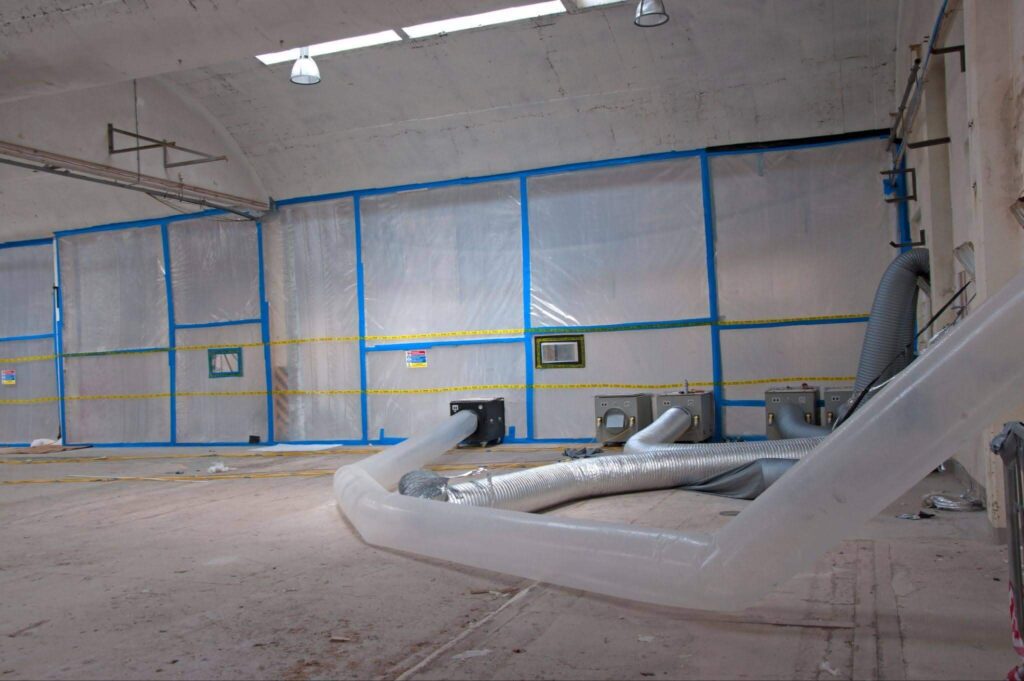
- Friable materials (lagging, sprayed coatings, most AIB) require full HSE-licensed contractors with enclosures, negative pressure units, and decontamination facilities
- Non-friable bonded materials (cement sheets, floor tiles, some textured coatings) may be handled under non-licensed or notifiable non-licensed work, but remain strictly regulated under regulatory standards.
Major budget drivers beyond the removal itself: complexity of enclosure and access, night or weekend working to avoid business disruption, hazardous substances waste transport and disposal charges (£400–£600 per tonne for high-risk material), and independent analyst attendance for four-stage clearance testing.
Example cost ranges for investors:
- Removal of AIB ceiling in a 200 m² retail unit: approximately £14,000–£24,000
- Full pipe lagging removal in a mid-size plant room: £50,000–£168,000 depending on extent
- Large industrial roof cement sheet replacement: potentially £100,000+ for extensive coverage
- Minimum charges for small licensed jobs: £1,000–£2,000, even for limited areas
Planning for Indirect and Project-Related Asbestos Costs
Asbestos-related budgets extend well beyond the removal contractor’s quotation. Investors who only price the headline removal figure consistently underestimate total remediation costs and face unexpected costs during delivery.
Main indirect costs to allow for:
- Temporary relocation of tenants and associated loss of rental income during works
- Additional scaffolding, access platforms, and containment erection
- Fire alarm isolations and temporary lighting within enclosures
- Redecoration and reinstatement of finishes after ACM removal
- Program contingency for the discovery of additional hidden ACMs
- Investors must assess ongoing costs related to environmental monitoring and compliance post-remediation
Budget separately for competent project management and independent analytical services-air monitoring, reassurance testing, and clearance certificates. These are typically separate from removal contractor costs and can add £5,000–£20,000 to mid-size projects.
Robust upfront planning with an experienced consultancy like Advanced Health and Safety can shorten program durations, reduce business interruption, and lower overall investment holding costs. Include asbestos contingencies explicitly in refurbishment and capex models, with scenario testing for “best case” (manage-in-place) versus “worst case” (large-scale removal before redevelopment).
Asbestos Management vs. Removal: Choosing the Right Strategy for Your Asset
Environmental remediation for asbestos does not always mean full removal. In many investment scenarios, a managed-in-place strategy is safer, cheaper, and fully compliant with regulatory requirements. The intended future use of a property affects cleanup standards and requirements, making this decision central to your development plans.
An asbestos management plan for a commercial property must contain:
- An up-to-date asbestos register with material locations, types, and condition ratings
- Risk assessments for each identified ACM
- A prioritized action plan with review dates
- Clear arrangements for informing staff, contractors, and tenants of ACM locations
Removal is usually preferred when: major refurbishment or change of use is planned, ACMs are damaged or deteriorating, materials are in areas likely to be disturbed by maintenance, or demolition is intended. Encapsulation or strict management is appropriate where ACMs are in good condition, in undisturbed locations, and will not be affected by planned works.
Investing in contaminated properties carries residual risks even after cleanup, so investors should integrate asbestos strategy into their wider environmental contamination and redevelopment plans, including brownfield regeneration and change-of-use projects. Advanced Health and Safety helps investors choose between managed-in-place and removal options by proactively addressing the balance between regulatory requirements, health risks to human health, and long-term asset strategy.
How Asbestos Interacts with Environmental Insurance and Transaction Structures
Asbestos is often treated differently from other environmental contamination in insurance policies and property transactions. Real estate investors need to read policy wording carefully and understand where coverage gaps exist. Banks are often hesitant to finance properties with a history of environmental contamination, making clear asbestos documentation a key tool for unlocking lending.
Environmental liability and pollution legal liability policies may include asbestos exclusions or only cover third-party claims for bodily injury and property damage, not the actual cleanup costs, unless specifically negotiated. Insurance can mitigate financial risks related to environmental contamination, and environmental insurance covers unknown contamination discovered post-acquisition, but investors must confirm that asbestos is explicitly included.
Common deal-structuring tools for managing asbestos liability exposure:
- Price adjustments to reflect known asbestos liabilities and remediation efforts required
- Escrow or retention arrangements: Environmental cleanup can be funded through escrow accounts held until remediation is verified
- Seller-funded remediation prior to completion
- Warranties and indemnities around asbestos information accuracy and completeness
- Voluntary cleanup agreements where the subject property has known contamination
Environmental findings can alter real estate deal terms significantly. Early asbestos sampling and costed remediation options give buyers stronger negotiating leverage and make it easier to secure tailored environmental insurance. Stigma related to a property’s contaminated history can affect its market value even after remediation, so quantifying costs upfront is essential for accurate property value assessment.
Advanced Health and Safety’s clear, quantified reports help lawyers, insurers, and lenders understand and price asbestos-related environmental liabilities in commercial real estate deals.
Worked Examples: How Asbestos Budgets Affect Real Investment Decisions
Example 1: 1960s Office Block, Manchester. An investor acquiring a six-story 1960s office building commissioned an R&D survey ahead of a planned refurbishment. The survey revealed extensive AIB above suspended ceilings across all floors. Initial contractor quotations for a full licensed removal came in at £150,000. By working with asbestos specialists to phase the removal floor-by-floor and encapsulate lower-risk panels in areas not affected by the refurbishment, the investor refined the final remediation budget to $95,000, a saving of over a third. Contaminated properties are often purchased at discounts compared to clean market value, and this investor negotiated accordingly.
Example 2: Light Industrial Conversion, South East. A former light industrial unit purchased in 2025 for conversion to trade counter use had asbestos cement roofing and limited internal ACMs (floor tiles and a small section of pipe lagging). The investor phased the roof replacement over two years while managing the internal ACMs in place through a formal asbestos management plan. Total survey and management costs in year one were under £5,000, with roof replacement budgeted at £45,000 in the capex program.
Example 3: Multi-Let Retail Parade, Midlands. Missing asbestos records on a multi-let retail parade threatened refinancing when the lender’s environmental quality requirements flagged the gap. Rapid management surveys and selective removal of damaged textured coatings allowed the investor to satisfy the lender’s environmental due diligence within three weeks. Environmental remediation can lead to higher future property values through successful cleanup, and in this case, the parade’s refinancing proceeded at improved terms. Property owners can be liable for contamination under CERCLA in US contexts, and similar liability principles apply in the UK, making complete records essential.
These examples illustrate how proactive asbestos sampling and realistic remediation budgets can turn apparent environmental problems into manageable, value-add opportunities for acquiring commercial real estate investments.
Working with Advanced Health and Safety to Control Asbestos Risk and Cost
Advanced Health and Safety is a UK health and safety consultancy specializing in asbestos surveys, sampling, management plans, and project oversight for commercial property investors and occupiers. Their team brings specialized knowledge to every stage of the investment cycle.
Core asbestos services relevant to investors:
- UKAS-aligned asbestos management and R&D surveys
- Bulk sampling and laboratory coordination with accredited labs
- Asbestos registers and management plans are compliant with current regulatory standards
- Contractor vetting and competency verification
- Independent air monitoring and four-stage clearance testing
- Support for permitting process requirements and regulatory compliance
The firm works across diverse sectors, including retail parks, logistics warehouses, office portfolios, education and healthcare estates, and at different stages, from acquisition through refurbishment to disposal. Advanced Health and Safety integrates asbestos work into wider health and safety management, CDM compliance, and environmental concerns, ensuring that refurbishment or remediation projects proceed legally and safely.
Contact Advanced Health and Safety early in the deal process for asbestos advice, budget estimates, and tailored environmental due diligence support. Whether you are conducting environmental assessments on a single asset or across a national portfolio, early engagement reduces risk, controls cost, and keeps your real estate transactions on track.

Q&A: Asbestos Sampling and Removal for Property Investors
This section answers common practical investor questions not fully covered in the main article, focusing on timing, frequency, and financial planning for asbestos risk. Responses are based on UK law and 2024–2026 market conditions. All answers are general guidance; investors should seek project-specific advice from Advanced Health and Safety or their professional advisers.
How often should I repeat asbestos surveys on an investment property?
Management surveys should be supported by regular re-inspections, typically every 12 months, or sooner if building condition changes, occupancy increases, or works are planned. A new R&D survey is required ahead of each distinct package of intrusive works, even if a management survey already exists. Insurers and larger occupiers may request evidence of up-to-date asbestos information as part of their own environmental due diligence. Investors should verify regulatory closure through official documents like No Further Action letters, where previous remediation has occurred, and some jurisdictions, such as Texas, require ongoing compliance monitoring for contaminated properties; similar monitoring principles apply in the UK.
Can I rely on the seller’s asbestos report, or should I always commission my own?
Always critically review the seller’s asbestos information: check the survey date, scope (management versus R&D), and whether a UKAS-accredited lab was used. Commission at least a gap analysis, and often additional targeted sampling, where reports are older than two to three years, limited in scope, or inconsistent with visible building fabric. Relying solely on a weak seller report can leave the buyer with unexpected environmental liabilities and limited recourse, especially if warranties are tightly drafted. Phase I ESAs are standard for due diligence and should flag any gaps in asbestos documentation. A Phase II ESA, involving soil and groundwater sampling, may also be required where contaminated land or contaminated soil is suspected on the subject property or at contaminated sites nearby.
What is the minimum asbestos budget I should allow in an initial appraisal?
For any pre-2000 commercial building, include a provisional sum for surveys and sampling, typically a few thousand pounds scaled to floor area and complexity, and a separate contingency for possible removal based on building type and intended works. Environmental due diligence can prevent unexpected legal liabilities, and early desktop advice from an asbestos specialist can refine provisional sums before bids are finalized. Ignoring asbestos in early appraisals is particularly risky for value-add and redevelopment strategies that rely on heavy refurbishment or change of use, where resource conservation and environmental quality obligations may apply.
Are there tax or capital allowance advantages to asbestos removal costs?
Some asbestos removal and associated making-good costs may be treated as revenue expenditure or qualify for certain tax reliefs, depending on project context and UK tax rules at the time. Environmental laws and the Recovery Act framework may also influence how remediation projects are categorized for tax purposes. Investors should speak with their tax advisers early to structure work in a way that maximizes allowable deductions and aligns with their wider capex program. Advanced Health and Safety provides the technical documentation-invoices, method statements, and clearance certificates-needed to support tax and accounting treatment, but does not give tax advice.
How quickly can asbestos sampling and reporting be completed during a deal?
Mobilization for straightforward sites typically takes a few days. Lab turnaround is 3–5 working days for standard analysis, or same-day for fast-track results at additional cost. Bottlenecks usually arise from access arrangements, tenant permissions, and security restrictions rather than the sampling itself. Involving Advanced Health and Safety early at heads-of-terms allows surveys and sampling to run in parallel with legal and financial due diligence, reducing the risk of last-minute deal delays. Environmental due diligence protects against unforeseen liabilities, and hazardous chemicals or hazardous substances in building fabric should never be a reason to walk away from otherwise sound real estate investments-they simply need to be priced and managed.